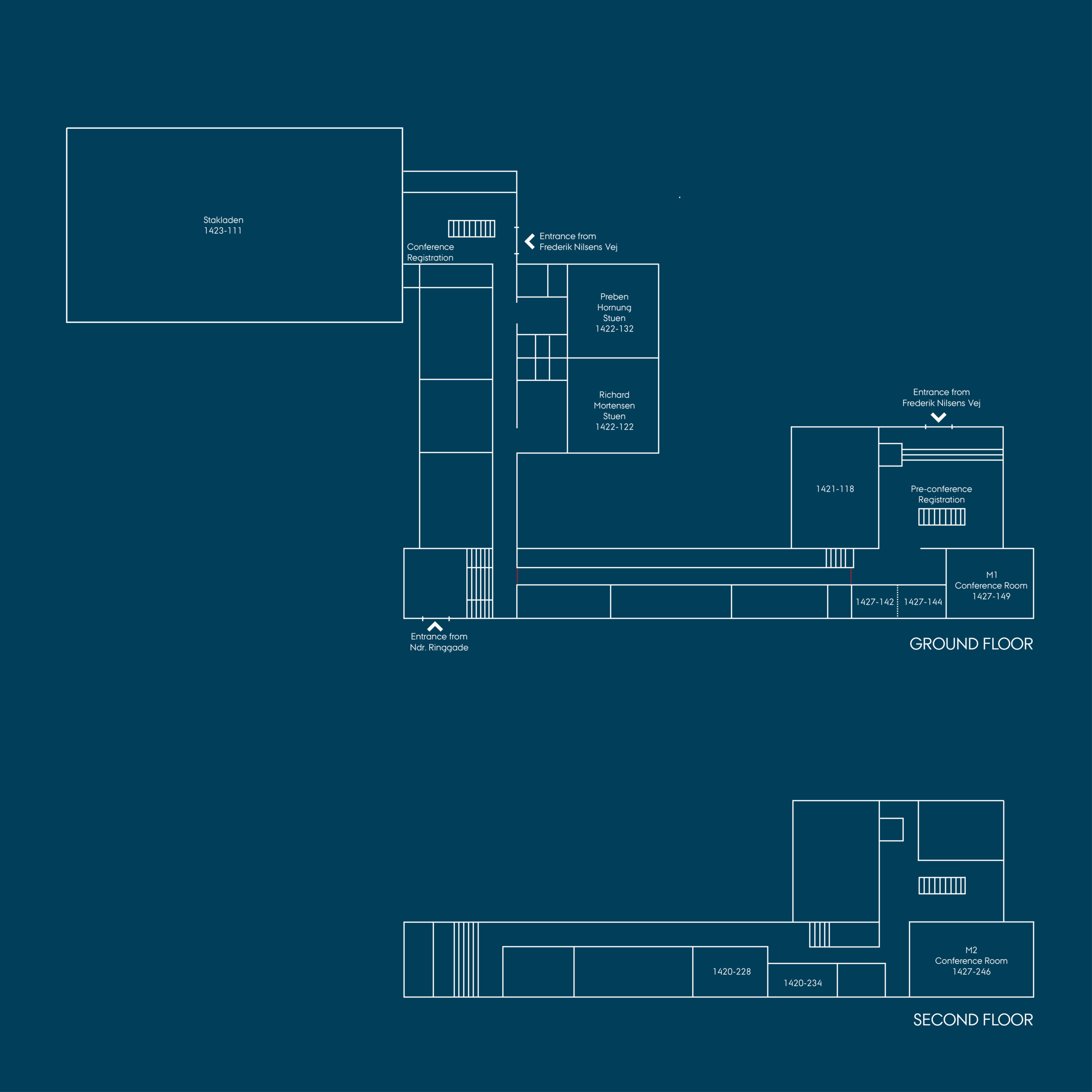
Programme

Jump to pre-conference programme (9–10 March)
Jump to conference programme (11–13 March)

Pre-conference programme (workshops and tutorials; times and session details may be subject to change).

Monday, 9 March

Morning

09:00–13:00
Workshop on Digital Humanities and Social Sciences / Cultural Heritage in Higher Education (room 1427-246)

▶ Workshop Programme

8:40–9:50 (CET) Welcome and introductions

8:50–9:10 (CET) Simanta Nandi – NexusWeave: Interweaving Disciplines in DHCH Education

9:10–9:30 (CET) Róbert Péter – AVOBMAT in the Classroom: Scalable Infrastructure for Multilingual Text and Metadata Analysis Without Programming

9:30–9:50 (CET) Young Min Kim – Scaling Collaborative DH for Cultural Heritage: Datafication, Micro-credentials, and Eco-memory with Ethical AI

9:50–10:10 (CET) Inés Matres – Participatory pedagogies through “difficult heritage”

10:10–10:30 (CET) Vicky Garnett – DARIAH-Campus and the classroom: how to publish and reuse open learning resources from the DARIAH community

10:30–11:00 (CET) Coffee Break

11:00–12:00 (CET) Roundtable check-in with regional DH in HE members

12:00–13:00 (CET) Joint discussion on emerging themes, preliminary regional survey results, and upcoming Working Group initiatives


End of programme

10:00–18:00
Frictions of the Digital: Rethinking Innovation and Engagement in the GLAM Sector (room 1420-228)

▶ Workshop programme

Read full workshop description here.

The workshop draws on the concept of digital frictions to rethink innovation as a process of negotiation rather than smooth progress. Combining talks (20 min), case-based discussions, and a collaborative mapping exercise, the workshop invites participants to identify key challenges and strategies for meaningful engagement with digital heritage.

10.00 Introduction: What is the landscape of frictions?

10.30-11.00 Rita Tamošaitienė. Vytautas Magnus University, Lithuania

Between Policy and Practice: Implementation of Cultural Heritage Digitisation Policy in Lithuanian Museums

11:00 – 11.10 Collaborative mapping

11.10-11.40 Elīna Vikmane. Latvian Academy of Culture / Latvian Museum Association, Latvia Diffusion of Digital Innovations in Museums: Operationalisation via the Digital Divide and Core Functions

11.40-11.50 Collaborative mapping

11:50-12.20 Merete Sanderhoff. SMK – Statens Museum for Kunst, Denmark

Productive Frictions: Wikipedians and GLAM professionals collaborating to enrich open knowledge of Danish cultural Heritage

12.20-12.30
Collaborative mapping

13.00-14.00 Lunch

14:00-14.30 Agnes Aljas, Pille Runnel. Estonian National Museum, Estonia

Productive Frictions: Negotiating Digital Innovation in the GLAM Sector

14.30-14.40 Collaborative mapping

14.40-15.10 Anne Rørbæk Olesen. National Museum of Denmark, Denmark

Digital innovation as everyday practice: Learnings from ten museums

15.10-15.20 Collaborative mapping

15:20-15.50 Martin Brandt Djupdræt, Thomas Linde Dideriksen. Den Gamle By, Denmark

Compiling Economic Transactions, Audience Experiences, and Historical Knowledge

15.50-16.00 Collaborative mapping

Short break

16.00-18.00 Reflection and systematisation exercise with all workshop participants


End of workshop programme

13:00–14:00
Lunch

Afternoon

13:30–17:30
AI-Assisted Archival Research in the Age of Vast Data and the Non-Canonical (20 seats) (room 1427-246)

▶ Workshop programme

Read full workshop description here.

13:30–13:45 — Welcome & Framing (15 min)

Session I — Humanities AI Infrastructure & Access
13:45–14:45 (60 min)

13:45–14:15
Abundance without Access
Adela Sobotkova (1), Brian Ballsun-Stanton (2)
Organization(s): 1 Aarhus University, Denmark; 2 Macquarie University, Australia

14:15–14:45
Influenza, Crowdsourcing and Humans In The Loop
Søren Poder (1)
Organization(s): 1 Aarhus University, Denmark

14:45–15:00 — Break (15 min)

Session II — LLM as Research Assistant & Discovery Scaffold
15:00–16:00 (60 min)

15:00–15:30
Exploring the Archived Web through AI Assisted Document Discovery
Victor Harbo Johnston (1), Christian Kaalund Kjeldsen (1)
Organization(s): 1 Aarhus University, Denmark

15:30–16:00
ChatHA – From an Information Retrieval Agent to a System of Expert Agents
Thomas Asselborn (1,2), Magnus Bender (3,4), Florian Andreas Marwitz (1,2), Sylvia Melzer (1,2), Ralf Möller (1)
Organization(s): 1 University of Hamburg, Institute of Humanities-Centered Artificial Intelligence, Germany; 2 University of Hamburg, Centre for the Study of Manuscript Cultures, Germany; 3 Aarhus University, Department of Management, Denmark; 4 Aarhus University, Center for Contemporary Cultures of Text, Denmark

16:00–16:15 — Break (15 min)

Session III — Fine-Grained Interpretation & Analytical Framing
16:15–17:15 (60 min)

16:15–16:45
Luminons: Fragment-Based Interpretation with LLMs for Archival Research
Lars G. Bagøien Johnsen (1)
Organization(s): 1 National Library of Norway, Norway

16:45–17:15
On the Classification of Interdisciplinary Research
Florian Marwitz (1), Sylvia Melzer (1), Shahrzad Ashourzadeh (2), Ralf Möller (2)
Organization(s): 1 University of Hamburg, Centre for the Study of Manuscript Cultures, Germany; 2 University of Hamburg, Institute for Humanities-Centered AI, Germany

Wrap Up — Collective Synthesis & Outcome
17:15–17:30 (15 min)


End of workshop programme

14:00–18:00
Workshop on Digital Humanities in Libraries, Archives and Museums (room 1421-118)

14:00–18:00
Frictions of the Digital: Rethinking Innovation and Engagement in the GLAM Sector (final) (room 1420-228)


Tuesday, 10 March

Morning

09:00–13:00
Lost in Noise? Data Quality and Representativeness in Cultural Heritage Collections (room 1427-246)

09:00–13:00
Markdown for Academic Writing (continues after lunch) (room 1421-118)

13:00–14:00
Lunch

Afternoon

14:00–18:00
Infrastructures to Reassemble Data Scattered across Domains, Borders and Media: an Encounter between Researchers and Memory Organisations (room 1427-246)

14:00–18:00
Markdown for Academic Writing (final) (room 1421-118)

14:00–18:00
Doctoral Consortium (room 1420-234)

14:00–18:00
Graph-based Text and Knowledge Modelling Using the ATAG Editor and Entity Manager (room 1420-228)


Preliminary conference programme (times and session details may be subject to change).

Wednesday, 11 March

Morning

08:30–10:30
Registration. Welcome coffee.

10:30–12:15
Opening & Keynote 1: Mike Kestemont & Folgert Karsdorp (room 1423-111)
Plenary session

12:30–13:30
Lunch (room 1423-111)

Afternoon

13:30–15:30
Session 1A (room 1422-122)
Session 1B (room 1422-132)
Session 1C (room 1427-149)
Session 1D (room 1427-246)

13:45–15:30
Panel 1 (room 1423-111)

15:30–15:45
Coffee break

15:45–16:15
1-minute lightning POSTER talks (room 1423-111)

16:15–18:00
Poster Session at Bibliotekshaven (The Library Garden)

Evening

18:30–20:30
Welcome Reception at Antikmuseet (Museum of Ancient Art)


Thursday, 12 March

Morning

08:30–09:45
Keynote 2: Katherine Bode (room 1423-111)
Plenary session

10:00–10:30
Coffee break

10:30–12:30
Session 2A (room 1422-122)
Session 2B (room 1422-132)
Session 2C (room 1427-149)
Session 2D (room 1427-246)

12:30–13:30
Lunch (room 1423-111)

Afternoon

13:30–15:30
Panel 2 and 3 (room 1427-149)
Session 3A (room 1422-122)
Session 3B (room 1422-132)
Session 3C (room 1427-246)

15:30–16:00
Coffee break

16:00–18:00
Session 4A (room 1422-122)
Session 4B (room 1422-132)
Session 4C (room 1427-149)
Session 4D (room 1427-246)

Evening

18:00–19:00
DHNB Annual General Meeting (room 1423-111)

19:30
Conference Dinner at ARoS Art Museum


Friday, 13 March

Morning

08:30–10:15
DT 1 (room 1423-111)

08:30–10:30
DT 2 (room 1427-149)
DT 3 (room 1427-246)
Session 5A (room 1422-122)
Session 5B (room 1422-132)

10:30–11:00
Coffee break

11:15–12:30
Keynote 3: Bolette Sandford Pedersen (room 1423-111)
Plenary session

12:45–13:30
Lunch (room 1423-111)

Afternoon

13:45–15:00
Closing Session (room 1423-111)
Conference prizes, announcements, and introduction of the next DHNB conference

15:00–15:30
Coffee and Goodbye (room 1423-111)